Oh no! Politics!
Now, I've always thought Mei's character design is adorable.
I've never played Overwatch, nor Diablo, nor World of Warcraft. In fifth grade, I played Starcraft for, like, two minutes. Probably less. I have played the two Lost Vikings games though! They're great.
As such, I'm categorically detached from Blizzard. I've had friends who, like so many others, have poured hundreds of hours into World of Warcraft. Seeing as the other, far less popular MMO, Final Fantasy XI, was sucking up all my time and lifeforce, my closest exposure to WoW was watching South Park's episode "Make Love, Not Warcraft." From that episode, a lingering question: "How does one kill that which has no life?"
So I have no authority on Blizzard's games. People seem to like them, though. I've had so many students who've played Overwatch and Hearthstone. I've also taught many Chinese students. ABCs, students from the mainland, Taiwan, and Hong Kong.
We're already aware of the Hearthstone player who Blizzard banned after Ng Wai Chung won a tournament and commented on Hong Kong's "revolution." Blizzard has also banned several other American University players who held up "Free Hong Kong" signs during a streaming competition. This happened two days ago.
The tournament rules state that participants are not allowed to say anything that could be deemed offensive to viewers. Blizzard also claims that “Every Voice Matters at Blizzard, and we strongly encourage everyone in our community to share their viewpoints in the many places available to express themselves.” Really?
Were these bans justified? A lot of people think no. Blizzard, and China, thinks yes. And the result? More protests. Notable Hearthstone players quitting the game. A planned protest for Blizzcon. Infuriated people online. Gamers becoming political.
Wrath may be a sin, but fury is a natural inclination of the human species when faced with injustice. But what is justice, or injustice for that matter? Not even Socrates could establish a categorical, valid definition that could hold up against scrutiny. Of course not: the nature of justice is subjective, elusive, and capricious.
The only thing that is certain in life is uncertainty, death, and human stupidity. Justice is never certain. Justice can be perceived as evil, depending on what one thinks. I might quote Hamlet too much, but "there is nothing either good or bad, but thinking makes it so."
However, whenever a man is in doubt, Chinese or not, he should turn to Confucius:
子曰其恕乎己所不欲勿施於人
"Do not impose on others what you yourself do not desire."
Confucius said it before Matthew did.
I never understand why politics tend to be so unethical. Confucius argues that without virtue, politics cannot be successful. Why have so many politicians, gaming companies, and governments disregarded virtue? Why is profit prioritized over morality?
Blizzard has two official responses to the public backlash regarding Ng Wai Chung's ban, one for English and another for Chinese audiences.
Blizzard's president has stated, "The specific views expressed by blitzchung were NOT a factor in the decision we made. I want to be clear: Our relationships in China had no influence on our decision."
According to the statement, the ban was not due to the content of the message, but the nature of its expression, the fact that such conduct could undermine efforts to maintain an "inclusive community." We cannot offend the Chinese, or the Chinese government specifically.
The focus should be on the game, not on politics. This I certainly understand.
Nonetheless, Blizzard changed Ng Wai Chung's ban from one year to six months (and the American University protesters received the same).
But (some) people can read, and think. They can detect discrepancies, formulate conspiracy theories, and use Google Translate (at least outside of China).
IGN's translation of the Chinese statement is as follows: "We express our strong indignation [or resentment] and condemnation of the events that occurred in the Hearthstone Asia Pacific competition last weekend and absolutely oppose the dissemination of personal political ideas during any events [or games]. The players involved will be banned, and the commentators involved will be immediately terminated from any official business. Also, we will protect [or safeguard] our national dignity [or honor].”
A Hearthstone player has been deemed a threat to China's national dignity.
The only way to know for certain whether Blizzard's bans were truly disconnected from a desire to maintain the favor of the Chinese government, is to... well, there's no way to know for certain.
We could have Hearthstone players shout out or hold signs with racist remarks and proclaim themselves as Neo-Nazis seeking to eradicate members of all other races. Let's see if Blizzard bans them. A Spanish or Catalan player should proclaim, "Liberate Barcelona!" and we'll see if Blizzard bans them. Bans for you, bans for everyone!
And there was absolutely no reason for Blizzard to punish the casters who were interviewing Ng Wai Chung.
When I complain about gaming companies such as EA, Konami, and Riot Games for employee maltreatment, sexual harassment, and other unethical practices, I rightfully and indignantly condemn them. Implementing justice, fairness, and ethics... this is really not as hard as it seems. Those in power who are selfish and ignorant might have us believe otherwise.
One cannot deny that China's influence appears to be encouraging Blizzard to make some questionable choices, increasing its renegade points. Blizzard would have us believe that China is not a factor in its decision-making, but how can it not be? So much money is at stake. Look at the parallel controversy with the NBA and China, another outcome of the Hong Kong protests. All this attention has even led to the U.S. passing the "Hong Kong Human Rights and Democracy Act." China is pissed. Blizzard is scared.
Warcraft and Hearthstone are very popular in China, and Tencent, the world's largest gaming company, owns 5% of Activision-Blizzard's shares. That appears to be an alliance, or at least a connection, between two of the largest and most profitable gaming companies in the world.

And they both seem concerned with staying on China's good list. Being on the other list, after all, could result in a cessation of business relations. That's still better than being prosecuted or persecuted.
Fear of prosecution and persecution. That's how the Hong Kong protests began in the first place. And this eventually led to bans.
--
A ban is much like censorship, is it not?
China's censorship is widely known. Solution? Use a VPN. Topics such as Taiwan independence, Falun Gong, Tiananmen, and even poor Winnie the Pooh are censored in China. Of course, China has banned South Park's recent episode about China's censorship and inhumanity as well.
In his original preface to Animal Farm, titled "The Freedom of the Press," George Orwell presented his argument against censorship. In the 1940's, no one was allowed to criticize Stalin, the admirable leader of Russia, Britain's ally, so four publishers rejected Orwell's novel. Though Orwell sought to draw attention to Stalin's tyranny and desecration of socialist ideals, only after decades passed did his satirical novel Animal Farm begin to command worldwide respect and acceptance. The Cold War allowed this to happen.
Orwell states, "Now, when one demands liberty of speech and of the press, one is not demanding absolute liberty. There always must be, or at any rate there always will be, some degree of censorship, so long as organized societies endure."
Of course a certain degree of censorship is necessary. We don't want young children seeing... certain images or words. But the Chinese government takes censorship too far.
Toward the end of his essay, Orwell also writes, "intellectual freedom is a deep-rooted tradition without which our characteristic western culture could only doubtfully exist."
But intellectual freedom is not merely an essential trait of western culture; it is necessary for humanity as a whole. I wish the Chinese government would realize this. Freedom of the press, freedom of thought and expression, with understandable limitations and restrictions on behaviors that could threaten the safety of others. Not totalitarian control.
I hate that word. Totalitarian. It's thrown out way too often. When we look up its synonyms, we find the following words:
authoritarian
autocratic
autarchic
dictatorial
tyrannical
oppressive
repressive
one-party
monocratic
absolute
absolutist
undemocratic
antidemocratic
illiberal
despotic
fascist
fascistic
Nazi
neo-Nazi
Stalinist
dystopian
I wish I could argue that none of these words could be associated with China. I wish.
Though I am detached from Blizzard, I cannot remain apolitical when talking about China.
Despite my limited Mandarin, I can whole-heartedly say I am Chinese, Chinese-American, Taiwanese-American. I love China, but I deeply resent the Chinese Communist Party. Yet, I appreciate that the government has taken the necessary steps to alleviate poverty and strengthen the nation as a whole, a nation that for centuries has been repeatedly disrespected, and to put it euphemistically, underrated. Everything is made in China. Once a country that exemplified innovation (paper, gunpowder, alcohol, silk, tea...), China now steals everyone else's ideas and intellectual property, sometimes improving, sometimes defiling them. China's economy is the second best in the world, and its military one of the strongest. China is powerful, and doesn't mistreat -most- of its people. The key word here is "most." Above all, social harmony is a goal, a core value of Chinese culture.
But China has become Big Brother in 1984. Censorship, revised history, and constant surveillance of citizens. Orwell was worried about Russia, but China resembles Oceania all the same. Between 1958 and 1962, the "Great Leap Forward" led to 18-56 million Chinese people dying of starvation or being massacred by soldiers. In 1989, the Chinese Communist Party sent its army to scatter and kill thousands of democracy protesters at Tianan Men and spread propaganda about the protesters seeking to overthrow the government. On October 1, 2019, the 70th anniversary of the party involves a massive military parade. So much to celebrate.
And of course, the Chinese government readily censors anything that upsets its authority figures. Facts are hidden or changed.
Truth straddles on contradictions. China certainly takes advantage of this fact, and deception, manipulation, and information control have become China's tools to maintain power and "social harmony."
But social harmony and democracy are not antithetical to each other. In truth, real social harmony requires humane treatment and freedom. Laws and limitations are a given, but excessive censorship and outright lies, which the Chinese Communist Party constantly perpetuates, are incongruous with virtue or justice. Propaganda's purpose is to manipulate the public and turn citizens to sheep. Ignorant and none the wiser.
As an admirer of Socrates, I too am a critic of absolute democracy. Chaos and idiocy are the likely results, for we are human. The democratic senate of Athens voted for Socrates to be executed because they thought he was sacrilegious and corrupting the youth, when all he wanted was for everyone to strive toward wisdom, virtue, and common sense. Seeing as he was a critic of democracy, it is unironic that democracy led Socrates' death. He chose poison hemlock and suicide over breaking the law and exile.
China also views democracy as a threat. But is democracy really threatening? I think Socrates still believed in the democratic process to an extent; he was just concerned that the majority of the population, being unwise and ill-advised, would make poor decisions when voting. It happens. Look at a president.
Democracy, qualified by laws and virtue, only makes sense. People need to be wiser, and they need to treat each other better. Social harmony does not entail prosecuting and persecuting dissidents or minorities who do nothing to hurt others.
The Chinese government continues to persecute Uyghur Muslims and send them to detention camps, disguised as "vocational training" centers, which in reality seek to brainwash members of the majority population of Xinjiang and destroy their religion and culture. Prisons or schools, one and the same in this context. The CCP has imprisoned, tortured, and killed Falung Gong practitioners and participants in the Tiananmen protests. According to some reports, Falung Gong prisoners have also had their organs harvested. The Chinese government kept a Nobel Peace Prize Laureate imprisoned, preventing him from accepting the award. That's worse than Konami not allowing Hideo Kojima to attend the Video Game Awards.
Orwell, a fervent democratic socialist, would likely condemn China's rigid information control. He would also detest how capitalistic the so-called "Socialism with Chinese Characteristics" truly is. Undemocratic yet capitalistic. A government that calls itself the "People's Republic of China." The Chinese Communist Party. Neither communist nor a republic. China's constitution states, "citizens of the People's Republic of China enjoy freedom of speech, of the press, of assembly, of association, of procession, and of demonstration." A constitution that lies. But China is very good at lying to its people. For people outside of China, however, we remain unconvinced.
China accused a U.S. official of "slander" when he condemned the government's maltreatment of Uyghurs. I understand that members of the Chinese government are likely not very good at English (I teach English to Chinese students, after all), but it's important to remember the definition of "slander":
slander (noun): the action or crime of making a false spoken statement damaging to a person's reputation.
slander (verb): make false and damaging statements about (someone).
It's not slander if it's the truth.
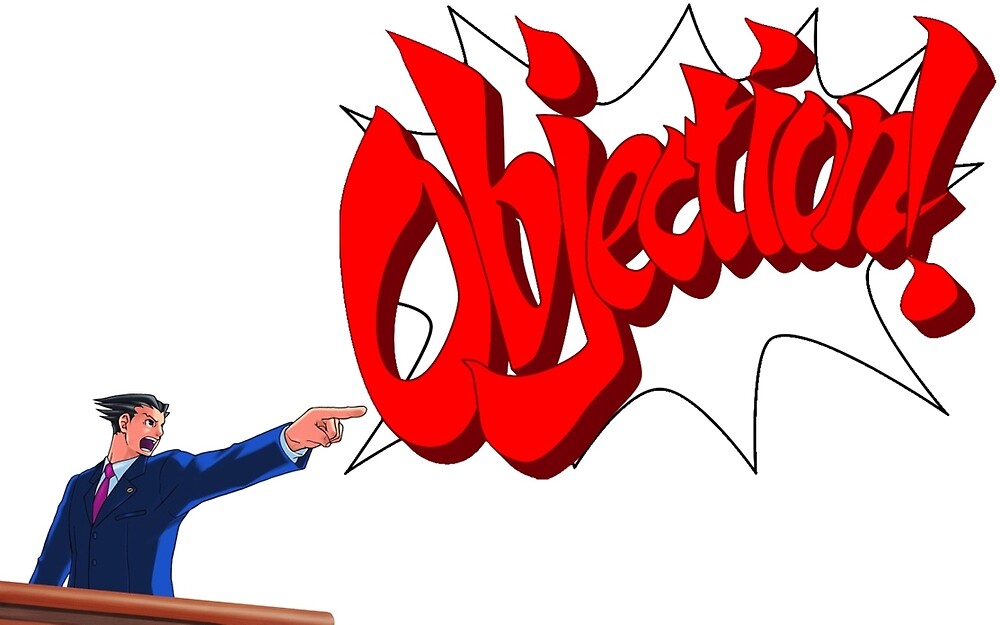
Today's Chinese government has lost sight of what it truly means to be Chinese. Objection! Slanderous! They would tell me, they would censor me. In a lot of ways, "China" is a misnomer. The land might be China, 中国, the "Middle Kingdom." But China never was at the center of the world; it's in the east. Are the Chinese people, most of whom are subservient to an unvirtuous, inhumane, disingenuous, and hypocritical regime, really Chinese? I controversially argue, Not Really. Even China's official written language is no longer real Chinese, but a dumbed down "simplified" text (although I acknowledge the goal of making literacy more accessible). Did Britain, the U.S., Canada, Australia, or any other English-speaking country dumb down the spelling of complicated English words? Of course not.
Being Chinese means having 孝 (filial piety), practicing 功夫 (hard work and mastery through time and effort) and living a virtuous life in accordance to "子曰其恕乎己所不欲勿施於人." "Do not impose on others what you yourself do not desire." Being Chinese means working hard, not cheating or lying to get ahead. The Chinese spirit embodies perseverance, resilience, respect, compassion, empathy, diligence, honesty, patience, and virtue.
There's no reason for freedom to not be included.
Humane treatment; it's not that hard.
Again, I repeat Confucius' words: "Do not impose on others what you yourself do not desire."
--
"Socialism with Chinese Characteristics"? Engels and Marx would lament. They might argue, and have argued, for revolution.
But the Hong Kong protests are not a revolution. I don't want them to be. I don't want there to be a war. There has already been too much needless violence. When Hong Kong returned to China under "One country two systems," did the Hong Kong people understand what this would entail or lead to? Of course not. Nothing is certain. But should everything be permitted? We're not assassins.
Recall Mohandas Ghandi and thousands during the Salt March; recall Mr. Luther King. Jr. and countless others participating in the Civil Rights movement; recall Henry David Thoreau's imprisonment for Civil Disobedience. There was no advocacy for violence.
Most of the Hong Kong protesters are teenagers and young adults in their early twenties. They might not have anything else better to do. They might be tired of school or unable to find jobs. But for sure, they're indignant and defiant of what they perceive as oppression and tyranny.
All this started with a silly extradition bill. It's been withdrawn, yet the protesters are only becoming more angry and violent, not less. But most of them are protesting peacefully. They have this right. Civil disobedience in light of injustice is a moral and inherent right of all citizens, so long as they take responsibility for their actions.
Young, angry kids, vandalizing public property, throwing petrol bombs, attacking police officers and cutting their necks with knives. They convince the Chinese government that democracy truly is chaos and a threat to social harmony. Many protesters have adopted Bruce Lee's philosophy of "Be Water" to avoid conflict and violence. Do that more, and use less fire.
Trying to start a revolution? Trying to save Hong Kong from China? Fighting for Hong Kong's autonomy? More peaceful protesting, less violence, please.
On the other side, aggressive and abusive officers, arbitrarily arresting whoever is unlucky, shooting and killing children, using violence when unnecessary.
Trying to uphold the law and maintain public order? Doing one's duty? More responsibility for actions, less violence, please. And fewer bullets and tear gas.
And for the Chinese government, please don't send the army, and don't kill people. Hundreds, thousands of years of Chinese blood being spilled, is enough.
Chapter 31 from the Tao Te Ching states,
夫佳兵者,不祥之器,
物或惡之,
故有道者不處。
是以君子居則貴左,
用兵則貴右。
兵者,不祥之器,
非君子之器。
不得已而用之,
恬淡為上,
勝而不美;
而美之者,是樂殺人也。
夫樂殺人者,
不可得志於天下矣。
故吉事尚左,
凶事尚右。
是以偏將軍處左,
上將軍處右,
以喪禮處之。
殺人之眾,以悲哀蒞之。
戰勝,以喪禮處之。
Translation (courtesy of taoistic.com):
Weapons are ominous tools.
They are abhorred by all creatures.
Anyone who follows the Way shuns them.
In peaceful times, the noble ruler honors the left side.
At war, he honors the right side.
Weapons are ominous tools.
They are not the noble ruler's tools.
He only uses them when he can't avoid it.
Peace and quiet are preferred.
Victory should not be praised.
Those who praise victory relish manslaughter.
Those who relish manslaughter
Cannot reach their goals in the world.
At times of joy, the left side is honored.
At times of grief, the right side is honored.
At battle, the second in command stands to the left,
And the commander in chief to the right.
This means they stand as in funerals.
When many people are killed
They should be mourned and lamented.
Those who are victorious in war
Should follow the rites of funerals.
--
Sorry and not sorry for getting political. I've written way more about China than Blizzard. But I'm detached from Blizzard. I'm not detached from China.
Some funny truths in closing.
Even though China's ban on video game consoles ended a mere four years ago, Chinese people have always seemed to have a problem with playing too many video games on their computers and phones. China also has a lot of "gold farmers" who sell World of Warcraft gold for real money. There are also a lot of Internet cafes in which people have died from playing an online game for too long without sufficient food, water, or sleep. A lot of Chinese also like to play PUBG or PUBG clones. Killing people in video games is okay, as long as this doesn't translate to killing people in real life.
If I played Hearthstone, Blizzard would probably ban me too. But maybe not, because I wouldn't discuss my opinions on Hong Kong or China during a tournament. But I wouldn't play in a tournament... I wouldn't play Hearthstone at all. Card games aren't really my thing.
China, for sure however, would censor me. My parents are from Taiwan, and I cannot support Taiwan "returning" to China if the Chinese Communist Party continues as it has. I care less for Taiwan's independence than for China's overall and moral improvement.
Apple listened to China's requests to remove the Taiwanese flag emoji and an app that helped users track the activity of the Hong Kong police. Blizzard and the NBA are taking measures to avoid further upsetting the Chinese government. China has influence, influence to undermine freedom of speech, truth, and morality. This should not be so. China should embody these ideals, not subvert them.
I love China, and I hate the Chinese Communist Party. Because I consider myself a real Chinese person, one who hasn't abandoned Chinese culture, philosophy, or history, I hate the Chinese Communist Party. I'm thankful for the good things they've done for the Chinese people, but I cannot stand their disregard of human rights. They do not follow Confucius' teachings nor the Way. But my hopes and dreams are that they improve, and cease hiding from truth, freedom, responsibility, or virtue.


