A lot of things have already been said about Final Fantasy VII's impact on gaming culture and history. For many, it was the entry point to the series and the Japanese role-playing game genre. I imagine words akin to the following have been frequently tossed around:
"Final Fantasy VII is the best Final Fantasy game. It's by far my favorite Final Fantasy."
- Someone who (probably) didn't play the other Final Fantasy games
"Why is Cloud's hair so spiky? How does he carry that ginormous sword?"
- Someone who saw Cloud for the first time
"I thought THESE GRAPHICS were good?"
- Someone who saw images/gameplay of the original Final Fantasy VII years after they last played it
"What's so great about this game? It looks like shit."
- Someone born after the year 2000
"Random encounters suck."
- Everyone
Repetition is a testament to a subject's popularity, and all of these sentiments have certainly been repeated over the years. When people hear about Final Fantasy, the number that always comes to mind is VII. Of course, there's also IV, VI, IX, and X...
Out of every game ever released, Final Fantasy VII has one of the most memorable plots and casts of characters. Cloud, First Class Soldier (not really), wielder of the (unwieldy) Buster Sword, and likely the most popular character in the entire Final Fantasy series. He's an infamous cross-dresser, suffering from dissociation and post-traumatic stress. His hero Sephiroth burned his hometown to the ground and killed his mother. Cloud's best friend died protecting him, and, while in a Mako-poisoned state, Cloud adopted Zack's identity as his own, having inherited Zack's honor, wishes, and dreams.

Players of Final Fantasy VII remember Tifa Lockhart's enormous breasts and scant clothing. They remember Sephiroth's excessively long sword. They remember Aerith's death.
They remember how it felt to step out of Midgar for the first time and into the open world of Gaia. The mind-fuck they experienced when Sephiroth managed to convince Cloud that he was just a Sephiroth clone and his memories and identity were fabricated. The sympathy they felt for Tifa, ridden with guilt, when she chose to stay by Cloud's side during his apparently comatose state.
Then we have Barret Wallace and Cid Highwind, who cuss a lot. But there's more to these characters than censored text. Cid's dream is to become the first man to enter space. Barret feels unconditional love for his adoptive daughter and an unrelenting desire to save the planet.
Red XIII is an awesome cat-dog that can talk. Cait Sith's a Shinra spy riding a giant Moogle. Yuffie is a ninja obsessed with stealing materia. Vincent is a vampire-esque gunsman who is unrequitedly in love with Sephiroth's mother.
But the player was told that Jenova, an extraterrestrial entity that crashed into the planet in a meteor, was Sephiroth's mother. Then somehow he assimilated Jenova and her supernatural powers into his own being. His goal is to summon a meteor to collide with the planet and absorb the planet's life energy to become a god.
The characters and story of Final Fantasy VII are complicated. Cool, but complicated. That's why we remember them. Their missing noses and giant forearms live forever in our memories.
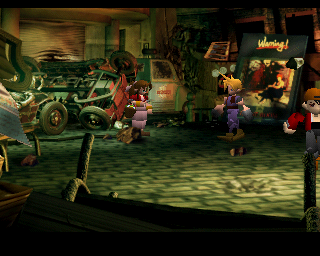

As a game, Final Fantasy VII doesn't do anything particularly or drastically different from previous entries in the series. Final Fantasy VI also takes place in a steampunk world with magical creatures and advanced technology, with a similar final boss who is a megalomaniac, aspires to become a god, and somehow grows angel wings. Main character deaths, like Tellah in Final Fantasy IV and Galuf in Final Fantasy V, weren't new either.
Though its plot might seem complicated, Final Fantasy VII's straightforward gameplay and relatively easy difficulty made it an JRPG far more accessible to the western audience than previous JRPG games. The 3D graphics and full-motion video sequences were groundbreaking at the time. People fell in love with this game, its characters, everything about it. And of course, FFVII sold millions of copies.
Final Fantasy VII's legacy is undeniable, and now the Remake is finally out. At least, the first part is. After completing it, I cannot help but feel that part 2 cannot come out soon enough. Knowing Square-Enix's track record when it comes to delayed developments (Final Fantasy XV, Kingdom Hearts III...), who knows when it will be completed. I can only hope that the entire game will be finished before I die of old age.
Inevitably, we will have to witness Aerith's death once again. I don't know if my heart can take it. I have a feeling it's going to be even more painful the second time around. The Remake has made the plot even more complicated, and it appears to be hinting at the possibility that we can alter the pre-destined course of events that was established in the original game. Maybe we can prevent Aerith's death or become Sephiroth's friend. Or we will simply despair in futility.
There's only one way to truly understand Final Fantasy VII's impact, why people wanted it remade for so long, and the implications of the Remake's story additions and alterations. You have to play these games for yourself.
And if you are smart and cultured enough, you will understand why Final Fantasy VII is the second or third best Final Fantasy, and one of the best (but perhaps not the best) JRPGs/games ever made.

No comments:
Post a Comment